
2016—2025Community Justice Centre (CJC) ‡ UX Research + DesignEmpowering a person to meet the law
How a decade-long relationship helped people navigate one of the most intimidating systems in their lives.
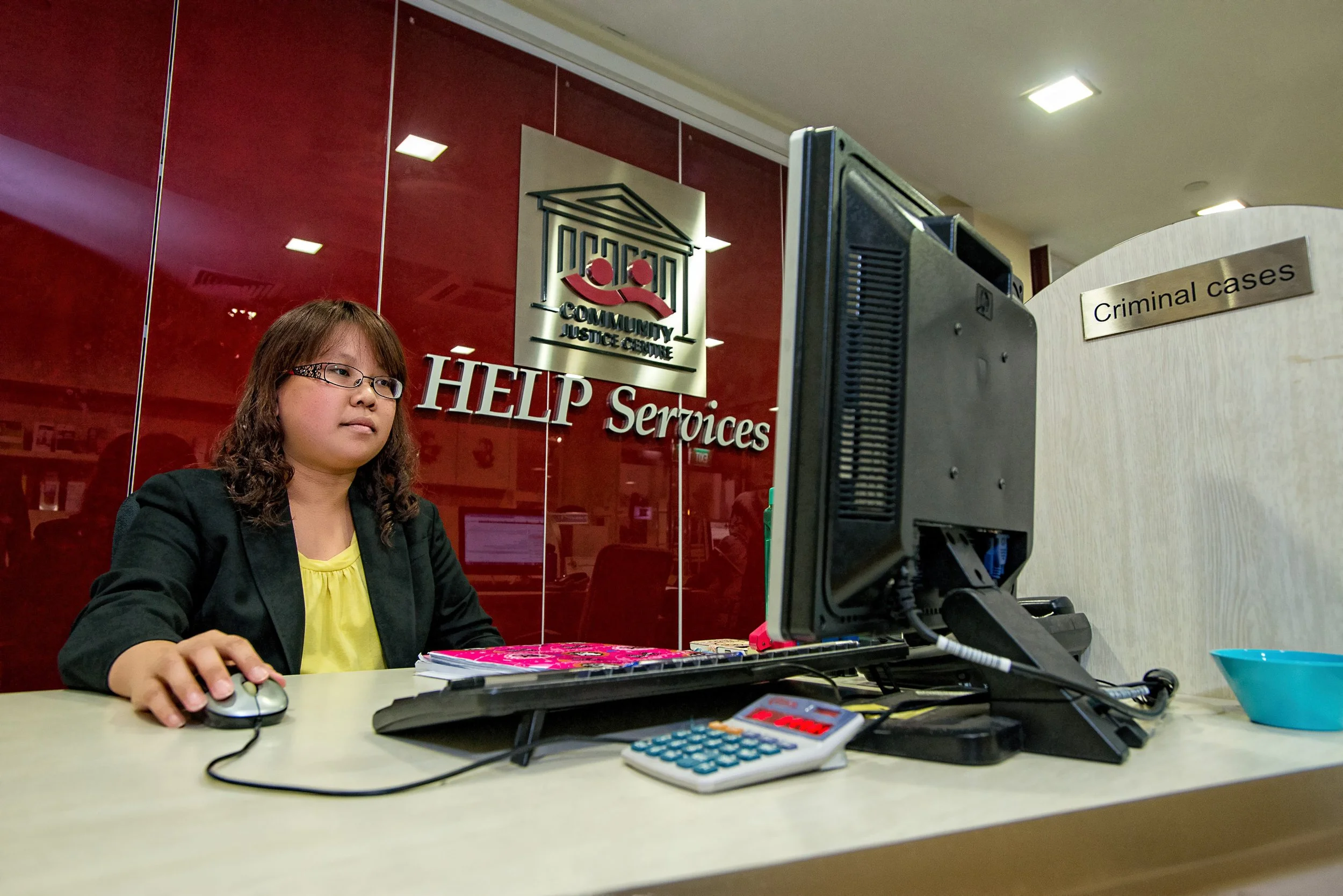
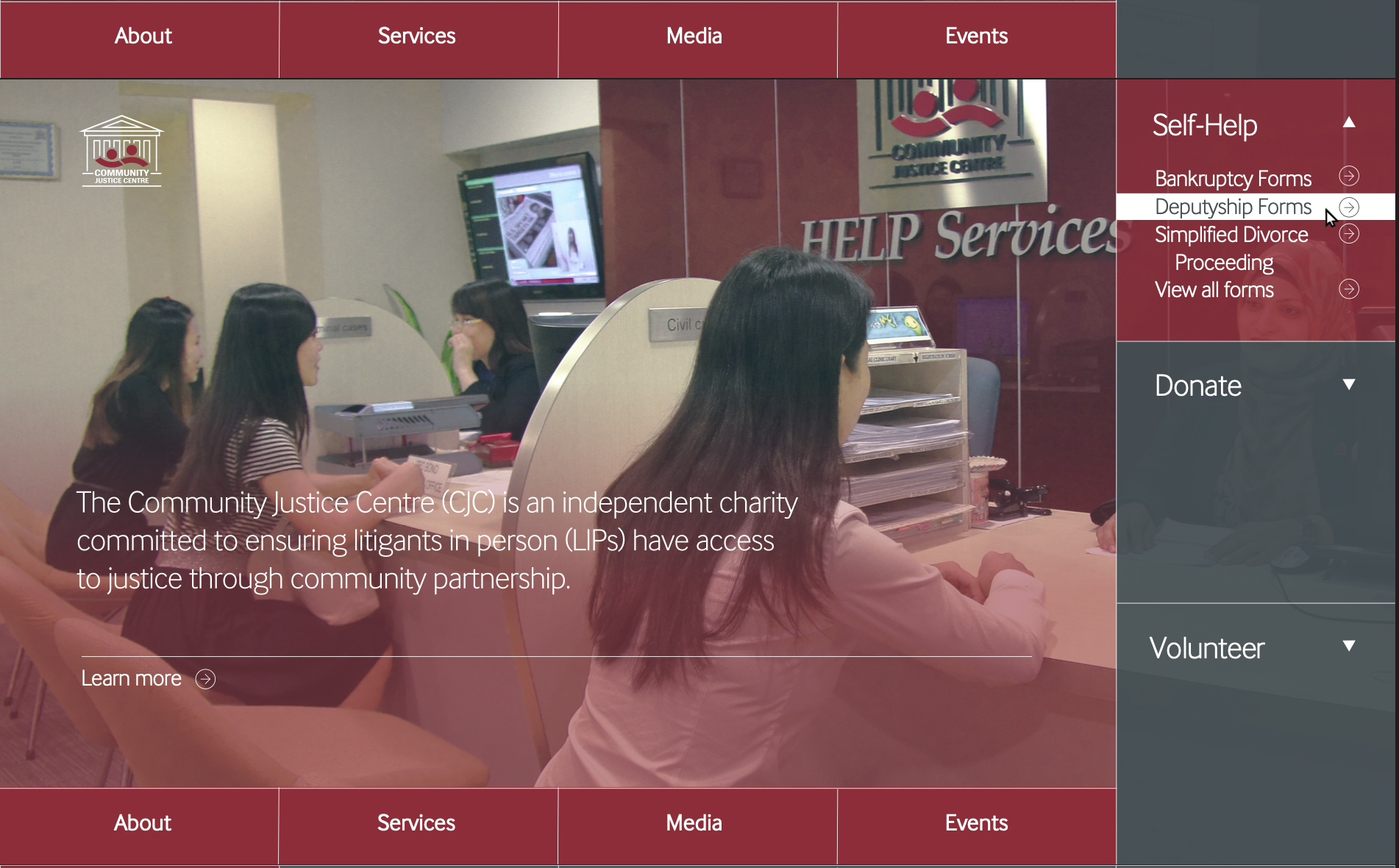
In 2016, CJC asked us to redesign its website and develop a self-help service for Litigants-in-Person — people navigating the courts without a lawyer, often because they could not afford one. On our first visit, the work in front of us became much clearer.
The waiting area was already filled with people referred directly from the courts, far more than any centre could realistically support one-to-one. It was still the early days of legal tech in Singapore, and many we met weren't comfortable using technology at all.
The people we were designing for were, on average, 46 years old, often with English as a second language, and facing the legal system alone at one of the worst moments of their lives. Given the emotional stress they were experiencing, recruiting participants for interviews was understandably challenging.
Instead, we worked closely with the Community Justice Centre (CJC) to develop evidence-informed assumptions about beneficiaries' needs, behaviours, and pain points, drawing on the organisation's extensive frontline experience.
We eventually recruited participants (the people whom the volunteers at CJC had built relationships with) and tested each assumption with our users:

"They're not tech-savvy."
Wrong. People were fluent with technology, phones especially. What they lacked was confidence with this content, not digital ability.
"They can't understand legal documents."
True. They stopped reading the moment language turned legalistic ("the english is scary") — but over-simplifying and leaving terms unexplained stranded them too."They're comfortable with online forms."
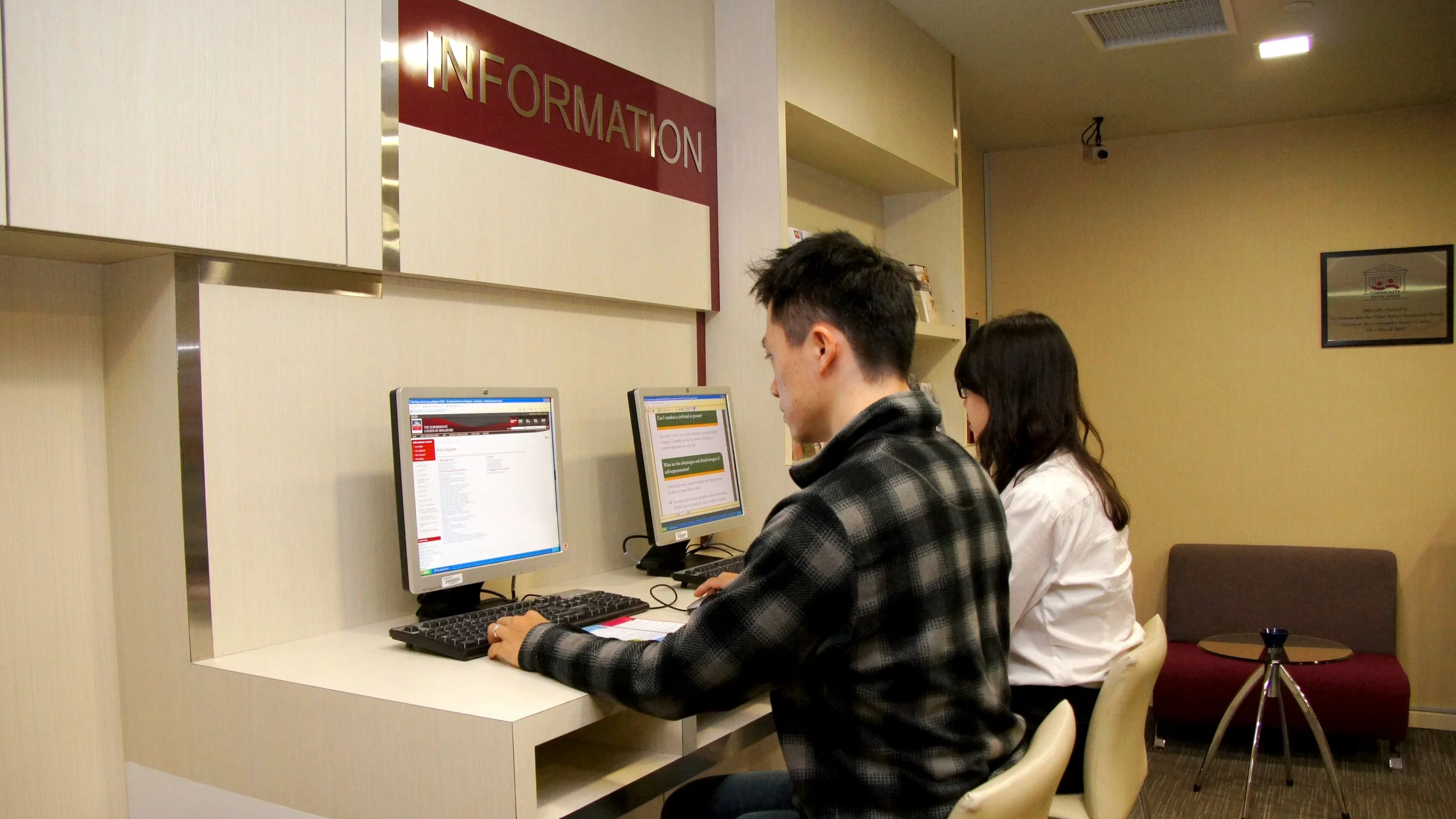
Wrong. They needed to feel ready before starting ("I need to be relaxed before I fill up any important forms") and reassured the form reached the right person.We proposed a kiosk within the centre, allowing beneficiaries to begin the same digital journey with support from volunteers while they waited. By introducing the platform in a familiar, low-pressure environment, we helped build confidence first, making it more likely they could continue independently later.
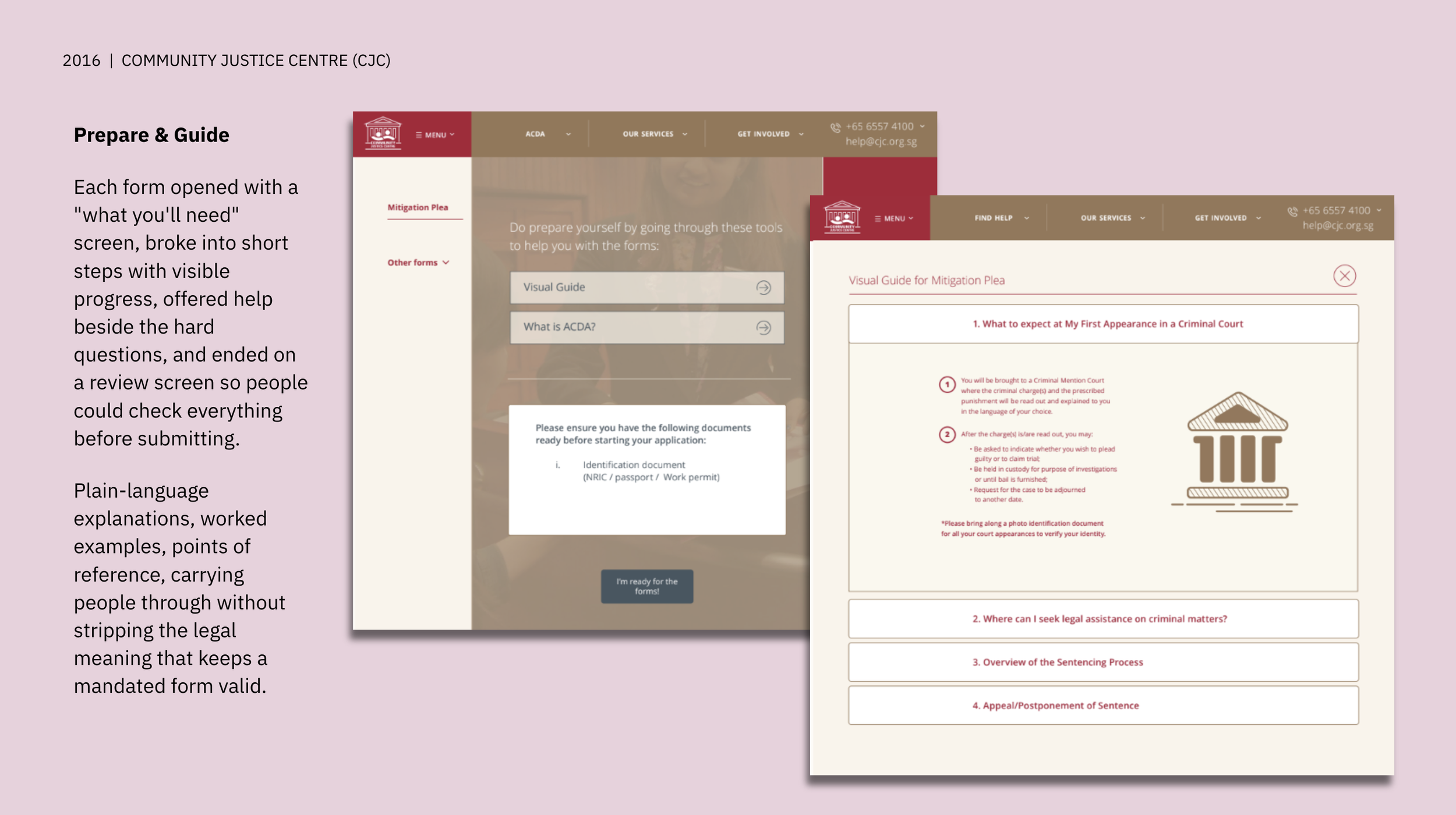
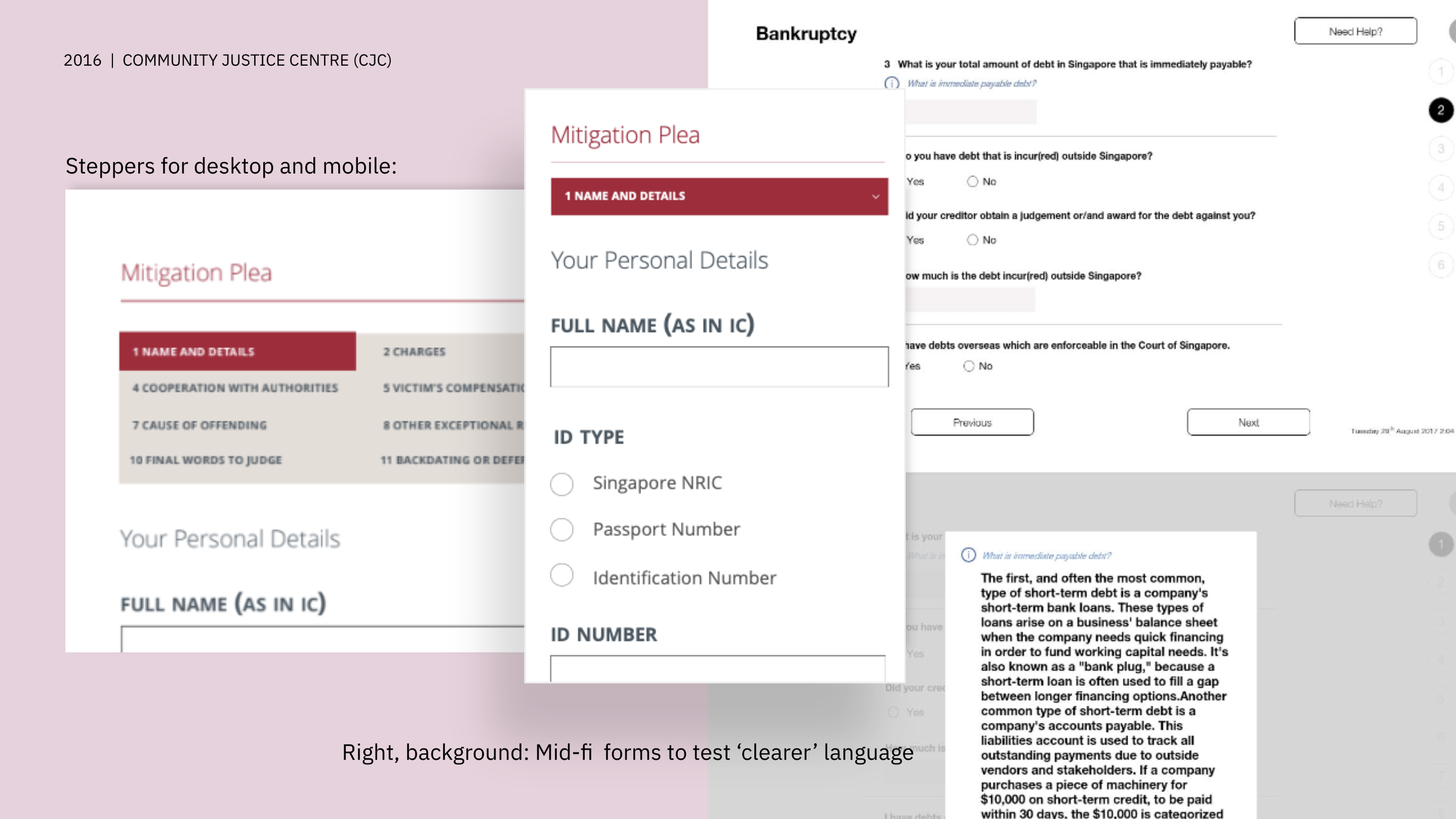
The principle we argued and stood for: guide, don't do.
CJC already had volunteers who filled out forms for litigants. Our research surfaced a quieter problem underneath: people didn't just find the forms hard — they felt helpless in front of them. "I need my daughter to help me; I can't do this." The obvious response to that is to help more — do more of it for them. We recommended the opposite.
Secondary research on dependency and agency pointed somewhere counterintuitive: doing the hard thing for a distressed person doesn't relieve the helplessness; it entrenches it. A litigant who is shown how, rather than done for, can take the form home, pause, gather the documents or approvals they're missing, and return on their own terms — in control, not dependent on being in the room with a helper. The point of "guide, don't do" was never to withhold help. It was to hand people back their own agency.
It did quiet double duty, too: as for the volunteers who guided them, they saw exactly where people got stuck — and that fed directly back into how the forms were shaped.
A note on CJC
The Community Justice Centre ceased operations in late 2025. What remains here is a record of a decade-long design relationship — and an attempt to capture the work, people and questions that shaped it.